
How 0–10V Modulating Ball Valves with PWM Feedback Deliver Precision Temperature Control
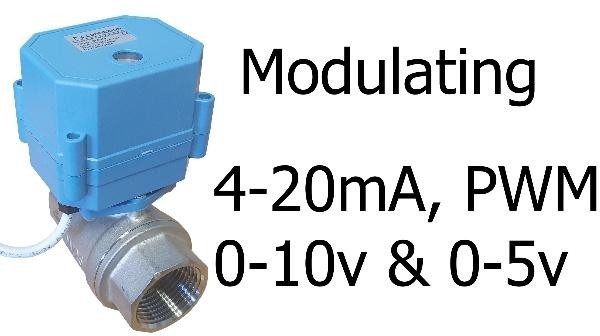
Understanding pulse width modulation, proportional valve positioning and the benefits of accurate flow control in applications such as poultry egg incubators, temperature regulation and industrial automation.
What Is a Modulating Motorised Ball Valve?
Unlike conventional motorised ball valves that simply open or close, a modulating motorised ball valve can be positioned at intermediate angles between fully closed and fully open.
This allows the valve to regulate the flow of water or other compatible fluids rather than simply switching the supply on or off.
For applications requiring accurate temperature regulation, controlled water circulation or repeatable flow adjustment, modulating ball valves offer a compact and energy-efficient solution.
The Connexion ABVM/9M series combines a stainless-steel ball valve with a compact electric actuator, providing proportional valve positioning through analogue control signals and optional PWM position feedback.
What Is PWM (Pulse Width Modulation)?
Pulse Width Modulation, commonly abbreviated to PWM, is a method of transmitting control or feedback information using a series of electrical pulses.
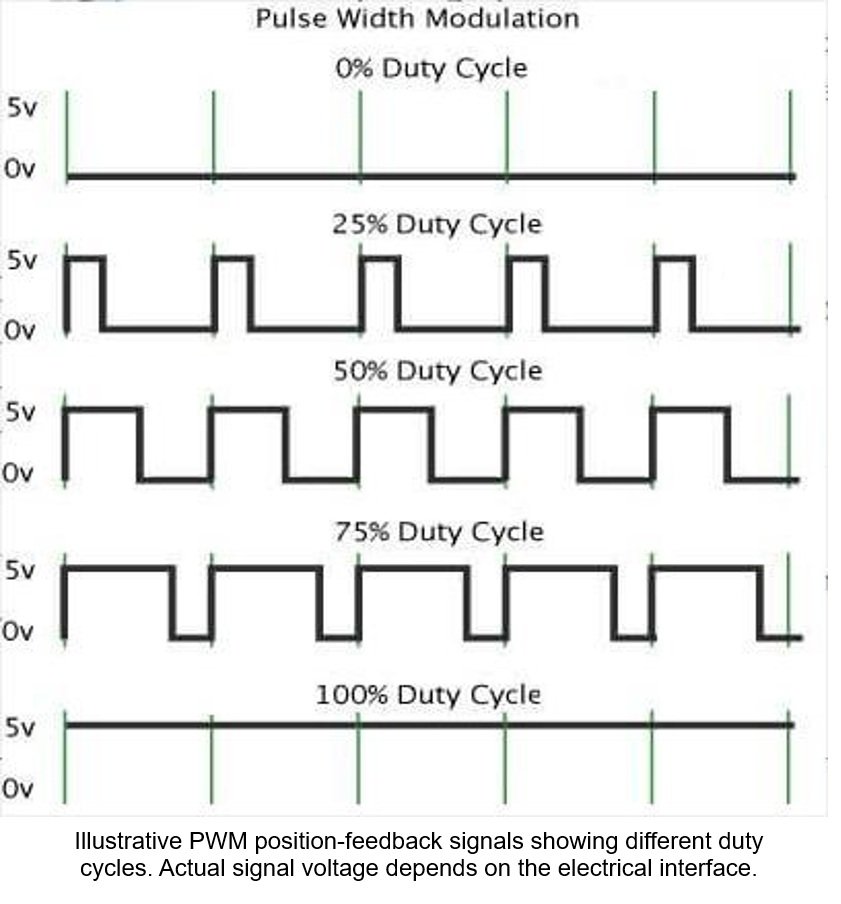
Rather than continuously varying the voltage, a PWM signal switches between high and low states at a defined frequency. The proportion of time the signal remains high during each cycle is known as the duty cycle.
For example:
• 25% duty cycle: Signal high for 25% of each cycle.
• 50% duty cycle: Signal high for half of each cycle.
• 75% duty cycle: Signal high for 75% of each cycle.
In a PWM position-feedback system, the duty cycle can represent the actual angular position of the valve.
This provides an electronic method for monitoring valve position without relying solely on mechanical position indicators.
Importantly, the precise relationship between duty cycle and valve angle depends on the actuator's configured feedback range.
How Does a Modulating Ball Valve Control Flow?
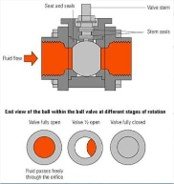
Inside the valve is a rotating ball with a passage through its centre.
When the ball is aligned with the pipework, fluid can pass through the valve. As the actuator rotates the ball towards the closed position, the available flow passage becomes progressively restricted.
A modulating actuator can stop at intermediate positions, allowing the connected control system to adjust the valve opening according to process requirements.
For example, a controller might command:
- 0° – Fully closed
- 22.5° – Approximately 25% of full angular travel
- 45° – Halfway through the valve's angular travel
- 67.5° – Approximately 75% of full angular travel
- 90° – Fully open
It is important to distinguish valve position from actual flow rate.
A ball valve positioned at 45° does not necessarily deliver 50% of maximum flow. Flow depends on the valve's characteristics, differential pressure and the connected pipework.
Where precise flow regulation is required, the control system can use feedback from temperature, pressure or flow sensors to continuously correct the valve position.
Precision Temperature Control in Chicken Egg Incubators
One particularly interesting application for modulating motorised ball valves is commercial poultry egg incubation equipment.
Successful incubation requires carefully controlled environmental conditions. Small variations in temperature can affect embryo development, hatch timing and overall incubation performance.
In incubators using water-based heating or cooling circuits, a modulating ball valve can regulate the amount of water passing through a heat exchanger or temperature-control circuit.
Rather than repeatedly switching the water supply fully on and off, the actuator can make controlled adjustments to the valve opening.
For example:
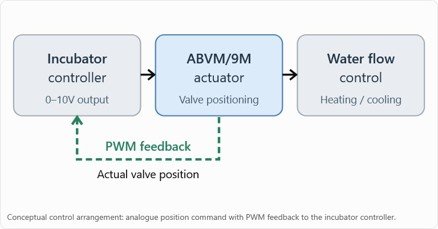
1. A temperature sensor continuously monitors the incubator environment.
2. The incubator controller compares the measured temperature with the required setpoint.
3. The controller sends an analogue positioning signal to the modulating actuator.
4. The actuator adjusts the ball valve opening.
5. The resulting change in water circulation or heat transfer helps correct the incubator temperature.
6. The controller continues monitoring and adjusting the system as required.
This approach allows a well-designed control system to maintain stable conditions with fewer abrupt changes in heating or cooling output.
A customer using our modulating motorised ball valves in chicken egg incubator equipment has highlighted the precise positioning capabilities as a particularly valuable feature.
The same principles can be applied to water-based humidity-control equipment where valve-regulated water flow forms part of the humidification process.
Understanding 4–20mA and PWM Feedback
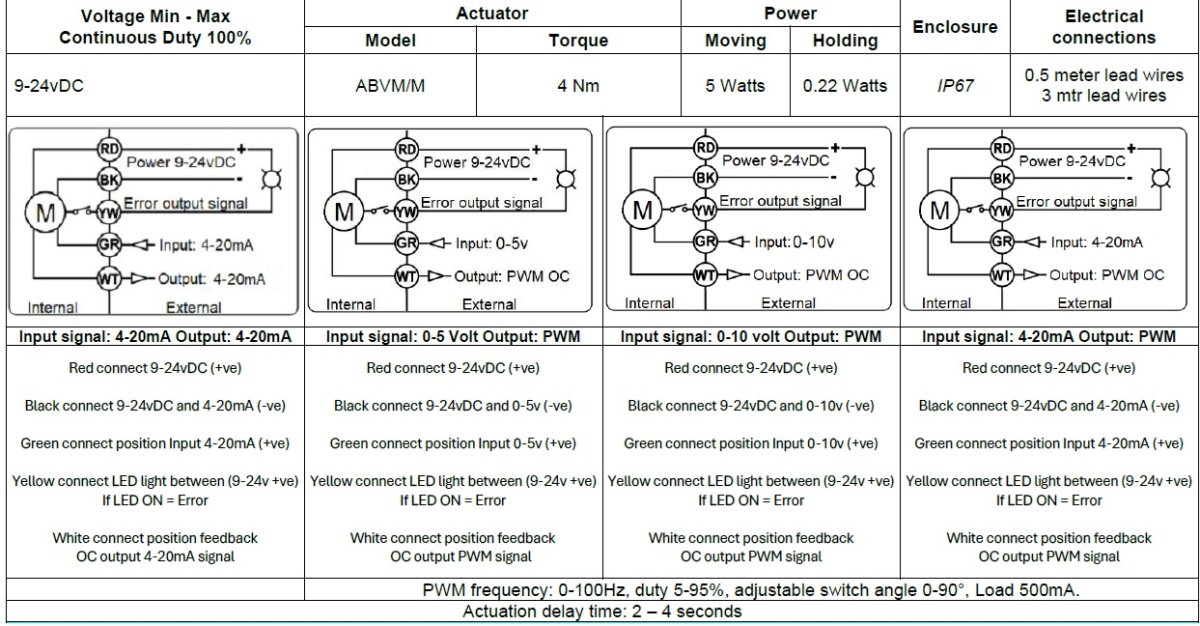
The ABVM/9M series offers different electrical signal configurations to suit industrial controllers, PLCs and automation systems.
4–20mA analogue control
A 4–20mA signal is widely used in industrial automation because it provides a standardised method of transmitting proportional control commands.
In a typical 0–90° valve-position configuration:
• 4mA represents the fully closed position.
• 12mA represents approximately 45°.
• 20mA represents the fully open position.
The actuator interprets the incoming signal and moves the valve towards the corresponding commanded position.
PWM position feedback
On configurations equipped with PWM feedback, the actuator provides a pulsed electrical output representing valve position.
This allows a compatible controller to monitor valve movement and determine whether the valve has reached the required position.
PWM feedback is particularly useful where the equipment's electronic control system is designed to interpret pulse-based position information.
The ABVM/9M technical specification identifies PWM feedback with a frequency range of 0–100Hz and duty-cycle range of 5–95%, depending on configuration.
The relationship between PWM duty cycle and valve angle should be confirmed for the selected actuator before integration.
Other available control options
The ABVM/9M range also includes 0–5V and 0–10V analogue input options, with feedback configurations selected to suit the application.
Benefits of Modulating Motorised Ball Valves
Compared with conventional on/off valve operation, modulating control offers several advantages.
Accurate positioning: The actuator can move the ball to intermediate positions to regulate the available flow passage.
Improved process stability:Continuous adjustment by a suitable controller can help reduce temperature fluctuations and unnecessary control cycling.
Reduced energy consumption:Controlled flow can help heating and cooling systems deliver only the output required, depending on the system design.
Low holding power:The ABVM/9M actuator is specified at approximately 0.22W when holding position, compared with approximately 5W during movement.
Position monitoring:Analogue or PWM feedback options allow the control system to monitor the actuator's reported valve position.
Compact construction:The integrated actuator and ball valve assembly is suitable for equipment where installation space is limited.
Water system compatibility:Selected stainless steel ABVM/9M configurations incorporate WRAS-approved sealing materials for suitable water applications.
ABVM/9M Modulating Ball Valve Technical Specifications
| Feature | Specification |
|---|---|
| Valve sizes | 1/4" to 1" BSP |
| Valve body | 304 stainless steel |
| Operating pressure | 0–10 bar |
| Media | Water |
| Media temperature | +1°C to +95°C |
| Actuator supply | 9–24V DC |
| Control inputs | 4–20mA, optional 0–5V or 0–10V |
| Position feedback | 4–20mA or PWM, according to configuration |
| PWM specification | 0–100Hz, 5–95% duty cycle |
| Actuator torque | 4Nm |
| Operating power | Approximately 5W |
| Holding power | Approximately 0.22W |
| Full travel time | Approximately 7 seconds |
| Enclosure protection | IP67 |
| Valve seals | PTFE / EPDM |
Specifications relate to the ABVM/9M series described in the product technical data sheet. Control and feedback options must be selected to match the equipment's electrical requirements.
Other Applications for Precision Modulating Ball Valves
Although poultry egg incubation is an excellent example of the benefits of proportional valve control, the same technology is suitable for many other industrial applications.
These include:
• HVAC heating and cooling circuits
• Water temperature regulation
• Industrial heat exchangers
• Laboratory temperature-control equipment
• Food and beverage processing
• Water treatment and circulation systems
• Agricultural climate-control equipment
• Automated machinery and OEM equipment
• Process water distribution and regulation
In each application, the ability to adjust valve position rather than simply switch between fully open and fully closed can provide greater control flexibility.
Choosing the Correct Modulating Ball Valve
When selecting a modulating motorised ball valve, engineers should consider more than the pipe connection size.
Important factors include the required flow rate, operating pressure, fluid compatibility, control signal, feedback requirements, power supply and expected frequency of operation.
For applications requiring highly accurate flow regulation, the valve's inherent flow characteristic and the overall control-system design are especially important.
A modulating ball valve provides controllable positioning, but the accuracy of the resulting temperature or flow regulation also depends on the sensors, controller and hydraulic system.
Precision Flow Control from Connexion Developments
Connexion Developments Ltd supplies an extensive range of motorised ball valves, including compact ABVM modulating valves, stainless steel assemblies and industrial actuated valve solutions.
Established in 1998, our family-run UK business provides technical assistance, valve selection support and extensive UK stock, backed by ISO 9001 and ISO 14001 certified management systems.
Whether you are developing commercial incubation equipment, automated heating systems or industrial process machinery, our technical team can help identify a suitable modulating valve and electrical control configuration.
Explore our range of modulating motorised ball valves at Solenoid Valve World, or contact our technical salesteam for assistance with your application.
Precision Temperature Control in Industrial Applications
Connexion Developments' ABVM/9M modulating motorised ball valves have been used in specialist equipment including MRI scanners, poultry egg incubators and industrial hot-water washing systems.
In one customer application, two modulating valves operate simultaneously under the control of an electronic temperature-control system.
The customer reports maintaining a hot-water temperature of approximately 78°C, with temperature variations of around ±0.3°C to ±1°C and rapid response to control adjustments.
These applications demonstrate how modulating motorised ball valves can contribute to accurate and responsive temperature regulation when integrated with suitable electronic controllers and feedback systems.