
PU Tubing Guide – Ester vs Ether (UV & Water Resistant Options)
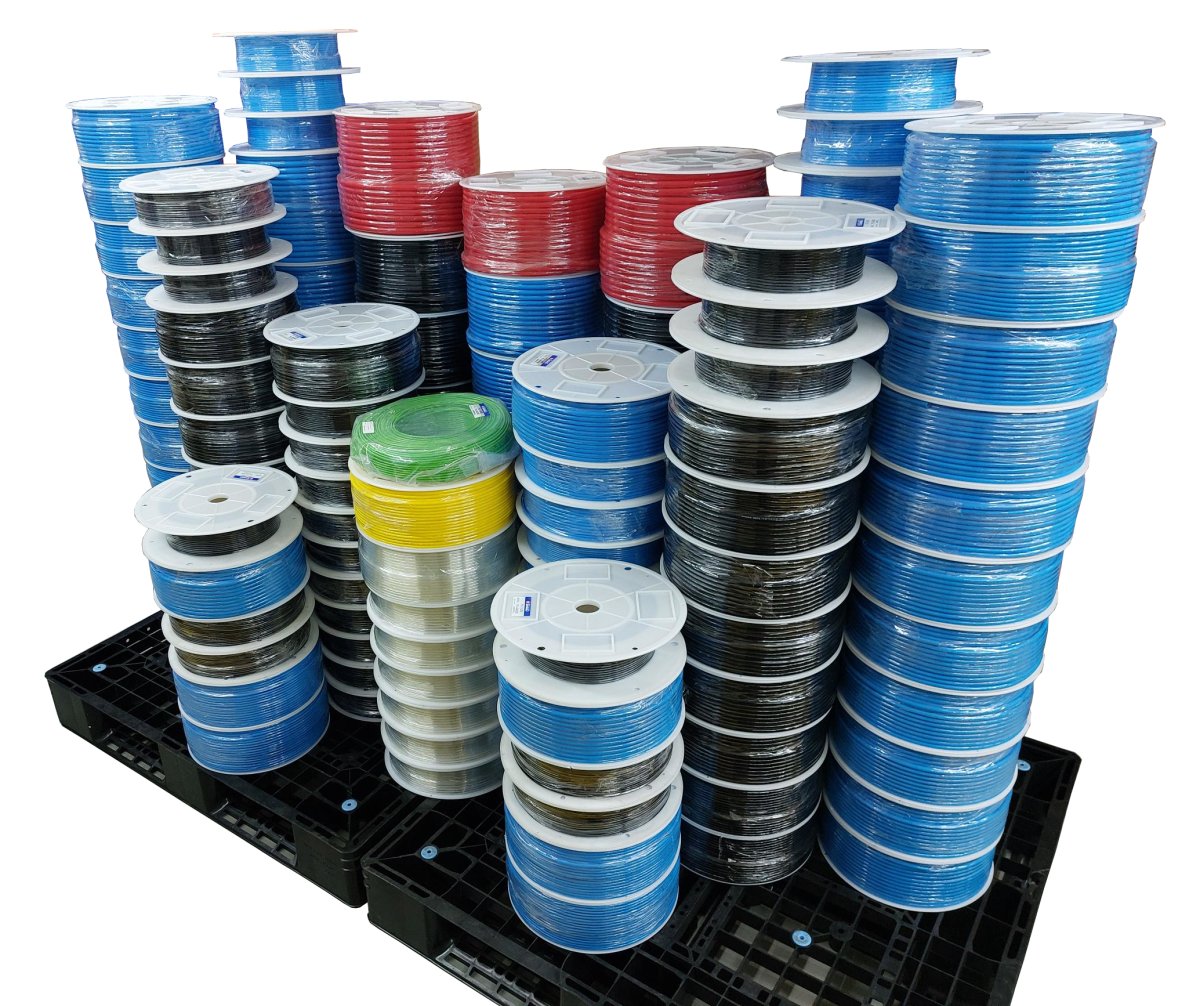
Polyurethane (PU) airline tubing is the industry standard for pneumatic control systems, automation, robotics, clean manufacturing, and general air distribution.
As the UK distributor of premium Shako PU tubing, we supply high-performance polyester- and polyether based polyurethane tubes designed for reliability, flexibility, and long service life.
PU Airline Tubing – Product Overview
Our PU tubing is supplied in a wide selection of metric and imperial sizes, multiple colours, and long continuous reels for production environments. Tubing is available in both polyester-based (standard) and polyether based (optional) formulations.
Key performance characteristics:
Outstanding flexibility and tight bend radius
Excellent abrasion, tear, and impact resistance
High working pressure with generous burst pressure margins
Smooth internal surface for optimal airflow
Available in 10+ colour options for system identification
Long reel lengths: 50 m, 100 m, 200 m depending on size
🛒 View standard PU tubing (Ester) → [here]
📞 Need UV / water resistant Ether PU? Contact us
Not sure which PU tubing you need?
Compare Ester vs Ether below
| Application | Recommended Material |
|---|---|
| Indoor compressed air | Ester PU |
| Outdoor use / sunlight | Ether PU |
| High humidity | Ether PU |
| Water exposure | Ether PU |
| Oil / grease environments | Ester PU |
When Should You Use Ether PU Tubing?
Ether-based polyurethane tubing should be selected where standard PU may degrade over time, particularly in:
Outdoor installations exposed to UV
Systems with moisture or condensate
Washdown or cleaning environments
High humidity industrial applications
Ether PU provides enhanced hydrolysis resistance, preventing cracking, embrittlement and premature failure.
Polyurethane Airline Tubing – Technical Specification Table
This section includes the most commonly requested metric and imperial sizes, with OD/ID, working pressure, burst pressure, bend radius, roll lengths, and part numbers.
Metric PU Tubing – OD/ID, Pressure Ratings & Part Numbers
| OD (mm) | ID (mm) | Working Pressure | Burst Pressure | Min Bend Radius (mm) | Roll Length (m) | Part Number |
|---|---|---|---|---|---|---|
| 4 | 2 | 22 bar / 312 psi | 66 bar | 15 | 200 | PU-0420 + colour |
| 4 | 2.5 | 15 bar / 217 psi | 45 bar | 15 | 100 | PU-0420-100M + colour |
| 4 | 2.5 | 15 bar / 217 psi | 45 bar | 15 | 200 | PU-0425 + colour |
| 6 | 4 | 14 bar / 203 psi | 42 bar | 25 | 100 | PU-0640-100M + colour |
| 6 | 4 | 14 bar / 203 psi | 42 bar | 25 | 200 | PU-0640 + colour |
| 8 | 5 | 15 bar / 217 psi | 45 bar | 30 | 100 | PU-0850 + colour |
| 10 | 6.5 | 14 bar / 203 psi | 42 bar | 40 | 100 | PU-1065 + colour |
| 11 | 8 | 6 bar / 85 psi | 18 bar | 35 | 100 | PU-1180 + colour |
| 12 | 8 | 13 bar / 188 psi | 39 bar | 50 | 100 | PU-1280 + colour |
| 16 | 12 | 9 bar / 130 psi | 27 bar | 100 | 50 | PU-1612 + colour |
| 16 | 13 | 5 bar / 70 psi | 18 bar | 100 | 50 | PU-1613 + colour |
Colour Options
Standard colours: Blue (BL), Black (B), Orange (OR)
Optional colours:
Red (R), Yellow (Y), Transparent (T), Green (G), White (W)
Buy Polyurethane tubing online.
Physical Properties – Tested to ASTM Standards
| Property | Value | Standard |
|---|---|---|
| Hardness (Shore A) | 98A | ASTM D-2240 |
| Tensile Strength | 600 bar | ASTM D-638 |
| Ultimate Elongation | 490–590% | ASTM D-638 |
| Taber Abrasion | 30–40 mg | ASTM D-1044 |
| Tear Strength | 155 bar | ASTM D-732 |
These results confirm the tubing’s suitability for high-cycle pneumatic applications.
QC Summary Report – Polyurethane (PU) Tubing Material
Material: Polyurethane Pellets (Grade EB-98A3)
Batch No.: 10118923
Shipment Date: 05 November 2025
Order No.: 25001251-SO
Download the test report
1. Test Results Overview
Hardness (Shore A – ASTM D2240)
Specified Range: 96 – 99
Result: 98
Status: Pass
Melt Index MI (8.7 kg / 205°C) – ASTM D1238
Specified Range: 30.00 – 50.00 g/10 min
Result: 37.23 g/10 min
Status: Pass
Moisture Content (IR Balance – Coating P. Method)
Specified Range: 0.00 – 0.30%
Result: 0.18%
Status: Pass
2. Summary
All measured parameters fall within the supplier’s controlled limits.
The polyurethane material meets the required QC criteria and is classified as Qualified / Acceptable for Use.
This batch is suitable for extrusion of high-performance PU pneumatic tubing.
3. Additional Notes
Material grade EB-98A3 is consistent with previous Shako/TPU supply batches.
No deviations, defects, or anomalies were recorded during testing.
QC documentation includes the original supplier inspection report and authorised signatures.
The material’s melt index, hardness, and moisture levels confirm stable processing behaviour for tubing extrusion.
QC Summary – PU Pellet Material (Batch EB-98A3)
All QC parameters (Shore hardness, MI, moisture content) fall within the supplier's controlled limits. This confirms the material is suitable for extrusion of PU pneumatic tubing.
Polyester vs Polyether Polyurethane (PU) – Full Material Science Comparison
Polyurethane airline tubing is manufactured using two primary material families: polyester-based PU and polyether based PU. Each type has distinct mechanical, chemical, and environmental characteristics that make it more suitable for certain applications.
This expanded comparison clarifies the technical differences to help engineers, OEMs, and pneumatic system designers choose the right formulation for their environment.
Polyester-Based Polyurethane (Standard Grade)
Polyester PU is the industry standard for general-purpose pneumatic airline tube.
Key Characteristics
Outstanding abrasion resistance
Ideal for high-cycle pneumatic systems where tubing regularly rubs against machine frames, tools, or cable tracks.
Excellent oil and fuel resistance
Performs well in environments exposed to lubricated air, hydrocarbons, compressors, and machining oils.
High tensile strength & mechanical rigidity
Offers precise dimensional stability, making it ideal for tight tolerances in push-in fittings.
Cost-effective
Typically around 10–30% cheaper than polyether formulations.
Limitations
Not recommended for high-humidity, wet, or water-contact environments
Polyester PU can hydrolyse over time, leading to:
Volume swell Reduction in mechanical strength Tube softening Hazy or cloudy appearance
Reduced hydrolytic stability
Long-term exposure to water or moisture accelerates degradation.
Typical Shelf Life
Approx. 3 years (assuming indoor dry storage)
Best suited for
Indoor pneumatic machinery
Dry factory environments
Robotics and pick-and-place systems
Air tools and automation
OEM machine-building using push-fit fittings
This is the default material for Shako’s standard PU airline tubing.
Polyether-Based Polyurethane (Premium Upgrade)
Polyether-based PU is the premium airline tubing choice, designed for harsh environments with moisture, water spray, condensation, outdoor conditions, or fluctuating temperatures.
Key Characteristics
Superior hydrolysis resistance
Unlike polyester PU, polyether PU does not readily break down in the presence of water.
It remains stable in water up to 50°C, even for extended periods.
Excellent low-temperature flexibility
Maintains elasticity and bend radius in cold environments where polyester PU can stiffen.
Fungus and microbial resistance
Critical for food processing, agriculture, HVAC, and damp industrial facilities.
High UV resistance
Ideal for tubing exposed to direct sunlight, outdoor installations, and solar heating effects.
Longer working life
Typically 5+ years, making it almost double the longevity of polyester PU.
Limitations
Higher cost
Generally 20–40% more expensive than polyester versions.
Water temperature limits
Although durable in ambient or warm water, it is not recommended for running water over 70°C.
Best suited for
Outdoor pneumatic systems
High-humidity environments
Water spray areas, washdown zones, and coolant exposure
Food and beverage equipment
Marine/aquaculture automation
Cold rooms and refrigerated production
Polyether PU is not the standard Shako supply, but it is available as an optional upgrade from the manufacturer.
Side-by-Side Technical Comparison
| Property | Polyester PU (Standard) | Polyether PU (Optional Upgrade) |
|---|---|---|
| Abrasion Resistance | ★★★★★ Excellent | ★★★★☆ Very Good |
| Oil Resistance | ★★★★★ Excellent | ★★★☆☆ Moderate |
| Hydrolysis / Water Resistance | ★★☆☆☆ Poor | ★★★★★ Excellent |
| UV Resistance | ★★★☆☆ Good | ★★★★★ Excellent |
| Low Temperature Flexibility | ★★★☆☆ Good | ★★★★★ Excellent |
| Tensile Strength | ★★★★★ High | ★★★★☆ High |
| Shelf Life | ~3 years | 5+ years |
| Cost | Lower | Higher |
| Outdoor Suitability | Limited | Excellent |
| Best For | General Pneumatics | Wet / Outdoor / Cold Environments |
Practical Engineering Summary
Choose Polyester PU tube if:
✔ You need a tough, abrasion-resistant tube
✔ The installation environment is dry
✔ Cost efficiency is important
✔ The system uses lubricated air
✔ You require excellent rigidity for push-in fittings
Choose Polyether PU tube if:
✔ The tubing is exposed to water spray or condensation
✔ The environment is outdoor or UV-exposed
✔ The application involves refrigeration or low temperatures
✔ Hygiene, mould resistance, or hydrolysis stability is critical
✔ Maximum tubing lifespan is a priority
Final Recommendation
For standard indoor pneumatic systems, polyester PU offers the best balance of price and performance.
For humid, outdoor, cold, or wet environments, upgrading to polyether PU dramatically improves service life and reliability.
PU vs Rubber Elastomers – Comparative Performance Chart
PU demonstrates excellent performance in:
Tensile strength
Elongation
Resilience
Tear strength
Abrasion resistance
Impact resistance
Compared against: NBR, EPDM, SBR, FPM, CR, IIR, NR, SIL.
PU ranks among the top for durability and dynamic mechanical performance.
Frequently Asked Technical Questions
What is Shore Hardness (Shore A – ASTM D2240)?
Shore Hardness is a standardised measurement of how resistant a material is to indentation. For elastomers like polyurethane (PU), this is measured using the Shore A scale, defined under the international test method ASTM D2240.
How the test works
A Shore A durometer uses a spring-loaded indenter that presses into the surface of the material with a controlled force.
The depth of the indentation is translated into a number on the Shore A scale:
0 Shore A → very soft, gel-like materials
40–60 Shore A → flexible rubbers (e.g., soft silicone)
90–98 Shore A → tough elastomers like high-performance PU
100 Shore A → extremely hard elastomers, almost rigid
Why PU Tubing is Typically Shore 95–98A
This hardness level provides:
High abrasion and wear resistance
Excellent dimensional stability under pressure
Low permanent deformation (low compression set)
Tight bend radius without collapsing
Long life under repeated flexing
This makes 98A PU ideal for:
Pneumatic airline systems
Push-in fittings (no cutting or leakage from deformation)
Robotic applications with constant movement
Industrial environments with mechanical abrasion
Why this matters in real-world pneumatic systems
The correct hardness ensures:
The tube stays round inside a push-fit fitting
The wall doesn’t collapse during tight bends
The tube resists scratching, gouging and wear
The internal bore stays smooth for optimal airflow
It maintains performance across temperature changes
A softer tube (70–80A) would kink more easily and perform poorly under pressure. A harder tube (100A) would lose flexibility, making installation difficult.
What is Melt Index MI (8.7 kg / 205°C)?
The Melt Index (MI) — also called Melt Flow Index (MFI) — is a standard measure of how easily a plastic melts and flows when heated. For polyurethane pellets used in PU tubing, this property is critical because it directly affects extrusion quality, surface finish, dimensional accuracy, and mechanical performance.
The test method is defined by ASTM D1238, the global standard for measuring the flow rate of thermoplastics.
How the Melt Index Test Works
During the MI test:
The material is heated to a standard temperature of 205°C.
A weight — in this case 8.7 kg — is placed on a piston above the molten polymer.
The molten polymer is forced through a precision die.
The amount of material that flows out over 10 minutes is weighed.
The result is expressed as:
Grams of polymer per 10 minutes (g/10 min)
What Melt Index Numbers Mean
A higher MI means the molten polyurethane flows more easily (lower viscosity).
A lower MI means the material is thicker when molten (higher viscosity).
The acceptable range for your PU tubing material is:
30.00 – 50.00 g/10 min
This tells us:
The material flows smoothly during extrusion
The surface finish of the tubing will be uniform
OD/ID tolerances will remain consistent
There is no excessive shear or degradation during extrusion
What is Polyurethane Moisture Content (IR Balance)?
Moisture Content refers to the amount of water absorbed into the polyurethane (PU) pellets before extrusion. Even small amounts of moisture can significantly affect clarity, mechanical strength, surface finish, and dimensional stability of PU airline tubing.
The Shako QC report, the moisture content was measured using the IR Balance Method, also known as Infrared Moisture Analysis — a precise and rapid technique used in polymer quality control.
(The batch measured 0.18%, well within the specification of 0.00–0.30%, see test report here.)
Applications of PU Airline Tubing
Pneumatic control systems
Solenoid valve actuation lines
Automation and robotics
Packaging machinery
High-speed pick-and-place
Air tools
Automotive air systems
Industrial production lines
Why Choose Connexion PU Tubing?
Manufactured using premium pellets
Consistent quality backed by ASTM standard testing
Wide colour and size range
Fast UK delivery with large stock holdings
Full technical support & material documentation
Compatible with all push-in and pneumatic fittings
Request Ether PU Tubing
We supply Ether-based PU tubing in all standard sizes and coil lengths.
👉 Contact our team for:
- Pricing
- Lead times
- Technical selection advice