What Are 2/2, 3/2, 5/2 and 5/3 Way Solenoid Valves?
Solenoid valves are used to control the flow of air, gas, or liquid in a wide range of industrial and commercial applications. The terms 2/2, 3/2, 5/2 and 5/3 refer to the number of ports (ways) and positions a valve has.
Understanding these valve types helps you choose the correct solution for your system — whether you need simple on/off control or precise pneumatic movement.
🔎 Quick Valve Selection Guide
- 2/2 Valves → Simple ON/OFF control
- 3/2 Valves → Diverting or exhaust control
- 5/2 Valves → Pneumatic cylinder movement
- 5/3 Valves → Mid-position / controlled stopping
🔧 2/2 Way Solenoid Valves (On/Off Control)
2/2 valves have 2 ports and 2 positions (open or closed). These are the most common type of solenoid valve used for basic flow control.
⚙️ How They Work
→ 2 ports: inlet and outlet
→ Opens or closes when energised
🏭 Typical Applications
→ Water systems
→ Gas control
→ Oil and fuel systems
→ General industrial flow control
✅ Key Benefits
✔ Simple and reliable
✔ Cost-effective
✔ Suitable for most media types
2/2 Normally Closed Solenoid Valves → View Products
2/2 Normally Open Solenoid Valves → View Products
2/2 Latching / Bi-Stable Solenoid Valves → View Products
🔧 3/2 Way Solenoid Valves (Diverting / Exhaust)
3/2 valves have 3 ports and 2 positions, allowing them to switch flow between outlets or vent pressure.
⚙️ How They Work
→ 3 ports: pressure, outlet, exhaust→ Switches between supply and exhaust
🏭 Typical Applications
→ Single acting pneumatic cylinders→ Air pilot systems→ Pressure release and venting
✅ Key Benefits
✔ Controls both supply and exhaust✔ Ideal for actuator control✔ Compact and versatile
3/2 Way Pneumatic Valves → View Products
%20diverter%20&%20switching%20valves.png)
3 way solenoid valves (3/2) are designed to switch or divert flow between two outlet ports, making them ideal for control, venting and directional applications.
These valves are commonly used in pneumatic systems, automation and fluid control where flow needs to be redirected or exhausted.
⚙️ How 3 Way Solenoid Valves Work
A 3 way valves have three ports and two positions:
→ One inlet port
→ Two outlet (or outlet + exhaust) ports
→ Flow is switched between ports when energised
They are used for diverting, mixing or venting media depending on configuration.
🔩 Available Configurations
→ Normally Closed (NC)
→ Normally Open (NO)
→ Universal (multi-function)
Each configuration controls how flow behaves when power is applied or removed.
🏭 Typical Applications
→ Pneumatic cylinder control
→ Air and compressed gas systems
→ Fluid diversion systems
→ Venting and pressure release
→ Automation and control panels
🔧 Materials & Options
→ Brass, stainless steel, aluminium and plastic bodies
→ Multiple seal materials (NBR, EPDM, FKM, PTFE)
→ Wide range of voltages and coil types
→ Various port sizes and connection options
✅ Key Benefits
✔ Enables flow switching and diversion
✔ Compact and efficient design
✔ Suitable for air, water and compatible fluids
✔ Multiple configurations available
✔ Fast UK delivery
🔧 5/2 Way Solenoid Valves (Pneumatic Cylinder Control)
5/2 Way Pneumatic Valves → View Products
%20pneumatic%20control.png)
5/2 valves have 5 ports and 2 positions, designed for controlling double-acting pneumatic cylinders.
Available in:
→ Single solenoid (spring return)
→ Double solenoid (bi-stable)
⚙️ How They Work
→ 5 ports: pressure, 2 cylinder ports, 2 exhausts
→ Switches airflow to extend or retract cylinders
🏭 Typical Applications
→ Pneumatic automation
→ Manufacturing equipment
→ Packaging machinery
→ Conveyor systems
✅ Key Benefits
✔ Precise cylinder control
✔ Fast switching
✔ Multiple configurations available
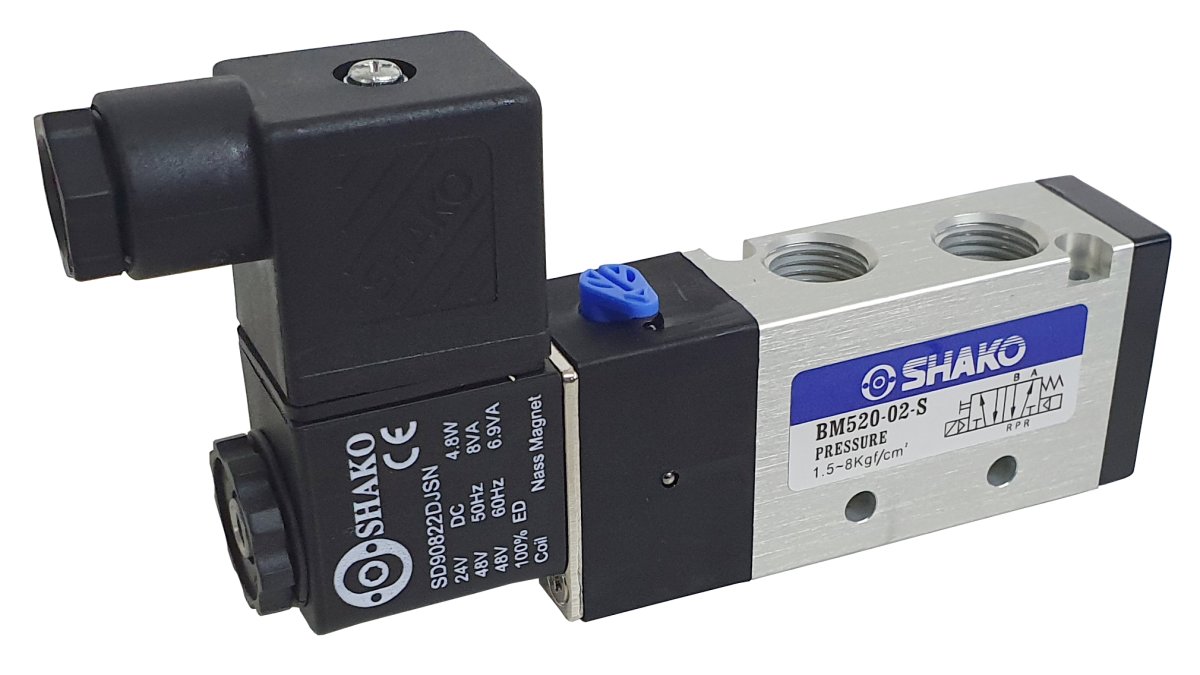
⚙️ 5/2 Single Solenoid Valves (Mono-Stable)
Single solenoid valves use one coil and a spring return, making them ideal for fail-safe applications.
🔁 Operation
→ Power ON → valve switches → cylinder moves
→ Power OFF → spring returns valve → cylinder resets
✅ Key Benefits
✔ Fail-safe operation (returns on power loss)
✔ Simple and reliable
✔ Fast response
✔ Ideal for safety-critical systems
🏭 Typical Uses
→ Basic pneumatic automation
→ Machine safety circuits
→ Air control panels
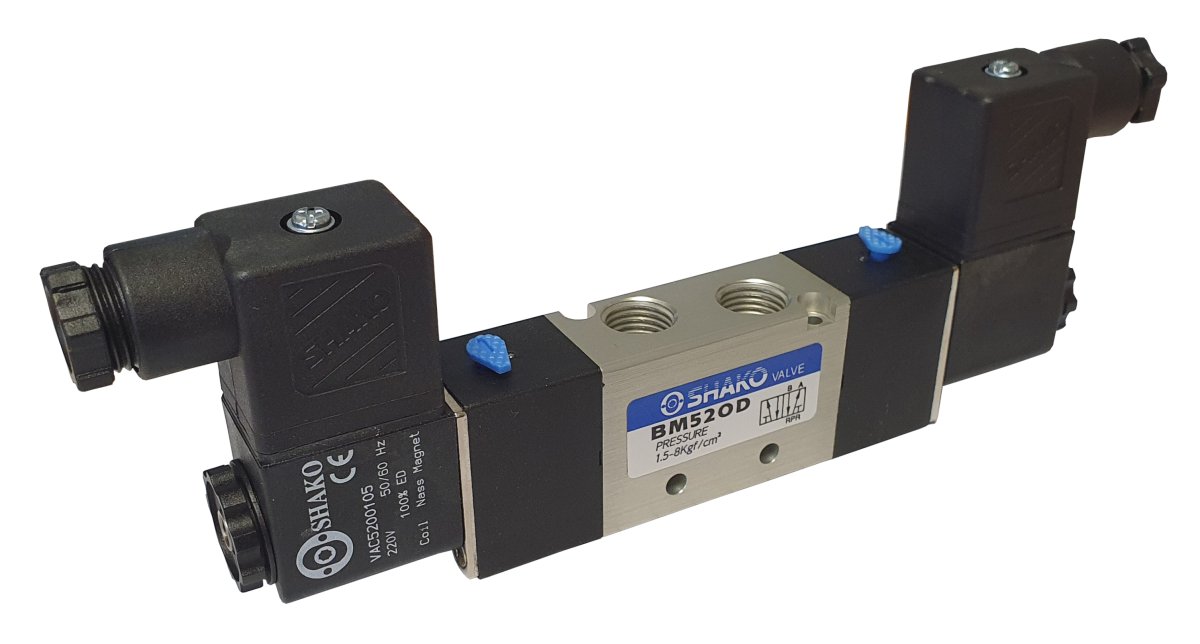
⚙️ 5/2 Double Solenoid Valves (Bi-Stable)
Double solenoid valves use two coils and remain in their last position without power.
🔁 Operation
→ Pulse coil A → cylinder extends
→ Pulse coil B → cylinder retracts
→ No power needed to hold position
✅ Key Benefits
✔ Holds position without power
✔ Energy efficient
✔ Ideal for memory-based control
✔ Precise directional switching
🏭 Typical Uses
→ Automated production systems
→ Conveyors & handling equipment
→ Applications requiring position retention
🔩 Available Options
→ Single (mono-stable) and double (bi-stable)
→ Voltages: 12V, 24V, 110V, 230V
→ Mounting: inline, NAMUR, manifold
→ Compact and high-flow designs
🎯 HOW TO CHOOSE
| Requirement | Best Option |
|---|---|
| Fail-safe (returns on power loss) | Single solenoid |
| Holds position without power | Double solenoid |
| Simple control | Single solenoid |
| Advanced automation | Double solenoid |
🔧 5/3 Way Solenoid Valves (Mid-Position Control)
5/3 Way Pneumatic Valves → View Products
%20centre%20closed%20exhaust%20&%20pressure.png)
5/3 solenoid valves are used in pneumatic systems where precise control and a defined centre (neutral) position is required.
These valves allow cylinders to extend, retract, or stop in a mid-position, making them ideal for controlled motion applications.
⚙️ How 5/3 Valves Work
A 5/3 valve features:
→ 5 ports (pressure, 2 cylinder ports, 2 exhausts)
→ 3 positions (left, centre, right)
→ Double solenoid (bi-stable) control
The centre position determines system behaviour when no coil is energised.
🔁 Centre Position Options
Centre Closed
→ All ports blocked
→ Cylinder holds position
Centre Exhaust
→ Cylinder ports vented
→ Load released / free movement
Centre Pressure
→ Pressure applied both sides
→ Balanced holding force
🏭 Typical Applications
→ Pneumatic positioning systems
→ Automation & robotics
→ Conveyor and handling equipment
→ Clamping and holding systems
→ Safety stop functions
🔩 Available Options
→ Double solenoid (bi-stable)
→ Multiple voltages (12V, 24V, 110V, 230V)
→ Inline, NAMUR & manifold mounting
→ Various flow rates and port sizes
✅ Key Benefits
✔ Mid-position (centre) control
✔ Precise motion handling
✔ Multiple fail-safe configurations
✔ Flexible system design
✔ Suitable for advanced automation
Shuttle, Quick Exhaust & Flow Control Valves → View Products
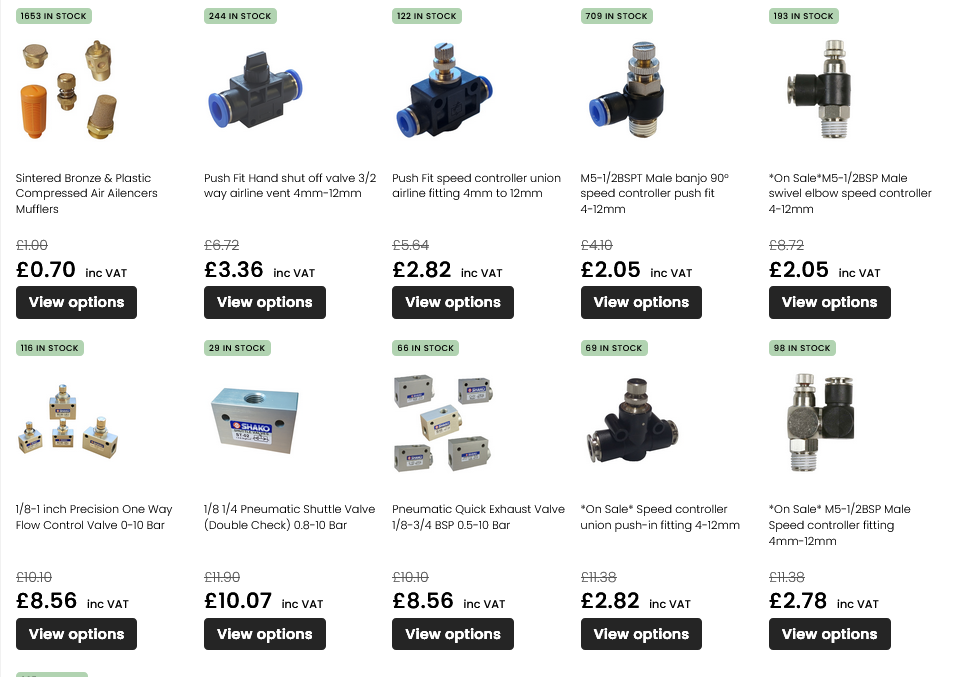
Flow Control Valves (Speed Controllers)
Flow control valves are used to regulate the speed of pneumatic actuators by controlling airflow in one or both directions.
Key features:
→ Adjustable flow rate
→ Compact inline or elbow designs
→ Meter-in and meter-out control options
Typical applications:
→ Controlling cylinder speed
→ Preventing shock or vibration
→ Fine tuning automation processes
Quick Exhaust Valves
Quick exhaust valves are designed to rapidly release air from a cylinder, significantly increasing actuator speed.
Benefits:
→ Faster cylinder movement
→ Reduced cycle times
→ Improved system efficiency
These valves are installed close to the actuator to minimise back pressure and maximise exhaust performance.
Check Valves (Non-Return Valves)
Check valves allow air to flow in one direction only, preventing reverse flow and protecting system components.
Common uses:
→ Maintaining pressure in circuits
→ Preventing backflow damage
→ Ensuring directional airflow control
Shuttle Valves
Shuttle valves automatically select between two pressure sources and direct the higher pressure to the output.
Applications:
→ Redundant air supply systems
→ Logic control in pneumatic circuits
→ Emergency or backup systems
Silencers & Exhaust Mufflers
Silencers are installed on exhaust ports to reduce noise levels and improve working conditions.
Benefits:
→ Lower noise emissions
→ Cleaner exhaust air
→ Protection against contaminants
Ideal for industrial environments where noise reduction is essential.
Pneumatic Manifolds & Distribution Blocks
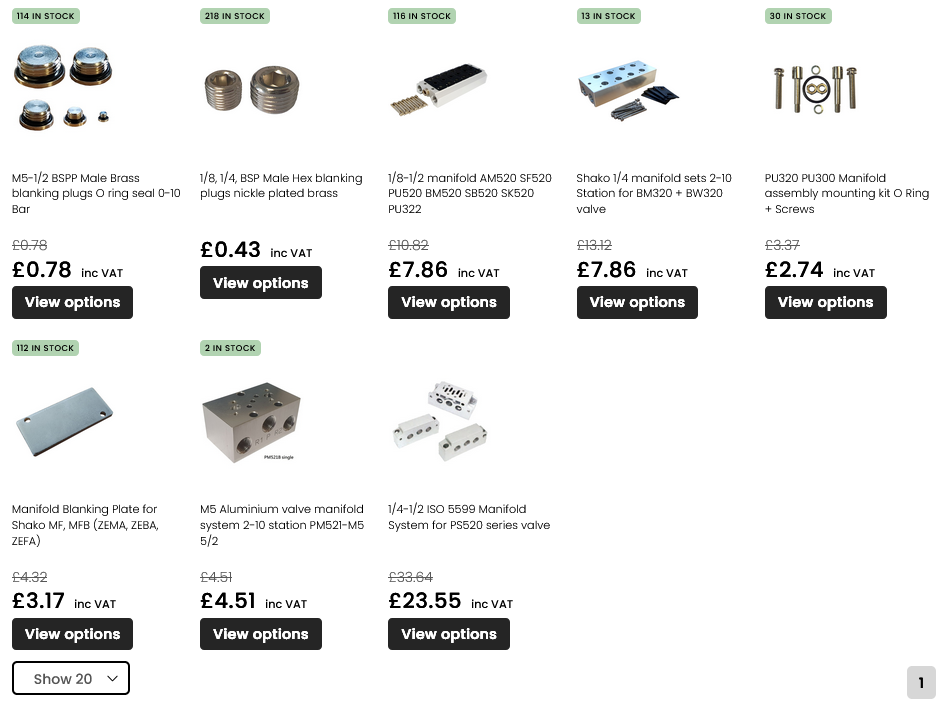
Manifolds are used to distribute compressed air to multiple outputs from a single supply.
Advantages:
→ Simplifies pipework
→ Reduces installation time
→ Improves system organisation
Available in multiple port configurations to suit complex pneumatic systems.
Choosing the Right Pneumatic Accessory
When selecting pneumatic accessories, consider:
→ Operating pressure and flow requirements
→ Port size and connection type
→ Installation space and orientation
→ Environmental conditions (dust, moisture, temperature)
Our range is compatible with standard pneumatic sizes including 1/8", 1/4", 3/8", and 1/2" BSP.
Air Filters, Regulators & Lubricators → View Products
Push-In Fittings + Tubing → View Products